

Table of Contents
ToggleINDIA’S DIGITAL REGULATION TO SAFEGUARD YOUNG USERS
TOPIC: (GS1) SOCIETY: THE HINDU
A U.S. court recently held Meta (Instagram) and YouTube accountable for addictive platform designs, ordering damages of USD 6 million.
India’s Regulatory Framework
- DPDP Act, 2023:
- Requires parental consent for processing children’s data.
- Prohibits tracking, targeted ads, and behavioral monitoring of minors.
- Penalties up to ₹250 crore for violations.
- IT Rules, 2021 & Amendments (2026):
- Age-based content classification (U, U/A, A).
- Mandatory parental locks and age verification.
- Harmful content removal within 3 hours.
- Labeling of AI-generated synthetic content (SGI).
- POCSO Act, 2012: Criminalizes online grooming and CSAM distribution; platforms must report offences.
- Juvenile Justice Act, 2015: Addresses online child exploitation and trafficking.
- State-Level Measures: Karnataka banned social media for under-16s; Andhra Pradesh proposed restrictions for under-13s.
Social Media for Young Users
- Addictive Design: Features like infinite scroll, autoplay, and algorithmic recommendations encourage compulsive use.
- Mental Health Risks: Exposure to curated content fuels anxiety, depression, and body dysmorphic disorder.
- Cyberbullying & Exploitation: Online anonymity enables harassment and grooming.
- Data Privacy: Children often lack digital literacy, making them vulnerable to misuse of personal data.
- Brain Development: Excessive screen time affects sleep, impulse control, and learning.
Measures to Mitigate Risks
- Parental Role: Co-viewing, setting healthy digital habits, limiting “doomscrolling.”
- Education: Teach children to identify dark patterns, misinformation, and deepfakes.
- Platform Design: Age-gating, removal of infinite scroll/autoplay for minors, prompts to log off.
- Legal Safeguards: Strict enforcement of POCSO and JJ Act; use of “Right to Be Forgotten.”
Conclusion
India’s DPDP Act, IT Rules, and child protection laws provide a strong framework, but effective enforcement and multi-stakeholder cooperation between parents, schools, platforms, and government are essential to safeguard young users in the digital age.
WOMEN VOTERS AND STATE POLITICS
TOPIC: (GS2) POLITY: THE HINDU
Women voters have emerged as a decisive force in State elections, shaping party strategies through welfare schemes and turnout patterns. Yet, their representation in Assemblies remains low, highlighting a gap between participation and political power.
Importance of Women Voters in State Politics
- Strengthening Democracy: High participation of women ensures elections reflect the voices of nearly half the population, making democracy more inclusive.
- Shaping Party Strategies: Welfare schemes and policies are increasingly designed with women in mind, showing their growing influence on political agendas.
- Social Empowerment: Active voting by women challenges traditional barriers and promotes gender equality in public life.
- Policy Outcomes: Women’s turnout directly impacts governance priorities, pushing parties to focus on health, education, safety, and welfare measures.
Freedom of Choice for Women Voters
- Independent Decision-Making: Women are increasingly voting based on their own preferences, not just family or community influence.
- Issue-Based Voting: Choices often reflect concerns about welfare, security, and livelihood rather than traditional identity politics.
- Diversified Support: Women voters are not tied to one party; their support shifts depending on performance and promises.
- Electoral Impact: Their freedom of choice makes them a decisive swing group, capable of altering election outcomes in closely contested States.
Rising Participation of Women Voters
- High Turnout: Women’s voting levels now match or exceed men’s in many States.
- Assam: Gender gap narrowed from -1.48% (1991) to +0.41% (2021).
- Kerala: Women’s turnout surpassed men’s in 2016 (+2.17%), nearly equal in 2021.
- West Bengal: Women overtook men’s turnout in 2011, maintaining a lead (+0.38% in 2021).
- Tamil Nadu: Historically low turnout, but parity achieved by 2011; near equal in 2021.
Representation in Assemblies
- Assam: Peaked at 11.11% in 2011, fell to 4.76% in 2021.
- Kerala: Stable but low, 5–9% over decades; 7.86% in 2021.
- West Bengal: Gradual rise, 13.61% in 2021 (40 women MLAs).
- Tamil Nadu: Volatile; 13.68% in 1991, dropped to 5.13% in 2021.
- Overall Trend: Despite strong participation, women remain underrepresented due to limited nominations and structural barriers.
Voting Patterns
- Assam: Shift from Congress dominance (2011) to BJP-led alliance gaining 44% of women’s votes in 2021.
- Kerala: Close contest between LDF and UDF; LDF secured 45% of women’s votes in 2021.
- West Bengal: AITC consistently strong among women (~50%); BJP rose to 36% in 2021.
- Tamil Nadu: Alternating support; DMK alliance led in 2021 with 45% vs AIADMK’s 42%.
- Impact: Women-centric welfare schemes (cash transfers, social support) are central to party mobilisation.
Govt initiatives:
Women’s Reservation Bill (2023): Provides 33% reservation in Lok Sabha and State Assemblies for women.
Panchayati Raj Amendments (1993): Mandated 33% reservation in local bodies, later extended to 50% in many States.
Election Commission & Party Efforts: Encourages political parties to field more women candidates, though progress is limited.
Capacity Building Programs: NCW and government schemes offer training, leadership support, and awareness campaigns for women in politics.
Conclusion
Women voters are reshaping electoral politics by influencing party strategies cross States. However, their low representation in legislatures underscores the need for reforms for reservation in Assemblies, and structural support.
ON GLOBAL TENSIONS AND INDIA’S ECONOMY
TOPIC: (GS3) ECONOMY: THE HINDU
The ongoing West Asia conflict has triggered macroeconomic stress in India, with the rupee hitting a record low, crude oil prices surging, and foreign reserves declining.
Economic Stress Points
- Currency Pressure: Rupee depreciated to ₹95 per dollar; foreign portfolio outflows of $8 billion worsened volatility.
- Oil Prices: Indian crude basket touched $156.29 per barrel, raising import costs.
- Reserves Decline: Forex reserves fell to $709.76 billion as RBI intervened to stabilise the currency.
- Fiscal Contradiction: GDP growth remains strong (~8.1%), but external buffers are weakening.
Revenue Structure Shifts
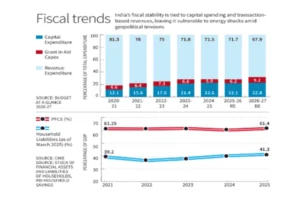
- Tax Composition: Revenue receipts rose to ~9.1% of GDP, but growth is driven by transaction-linked taxes (GST, financial levies) rather than income taxation.
- GST Dependence: Collections reached ₹22.8 lakh crore in FY25, making fiscal health sensitive to consumption and trade activity.
- Vulnerability: External shocks reduce transactions, weakening GST buoyancy and widening fiscal gaps.
Oil Price Impact
- India imports 85–87% of crude oil, making it highly exposed.
- A $10/barrel rise can:
- Increase CPI inflation by 0.2 percentage points.
- Widen CAD by $9–10 billion (~0.4% of GDP).
- Reduce GDP growth by ~0.5 percentage points.
- Past example: Post-Ukraine war, excise duty cuts on fuel caused ₹2.2 lakh crore revenue loss; subsidies rose to ₹3.2 lakh crore.
Household Vulnerabilities
- Consumption: Accounts for 61.4% of GDP, but household debt rose to 41% of GDP by 2025.
- Savings: Net financial savings volatile, dipping to 3–4% of GDP before recovering.
- Energy Costs: LPG shortages and rising refill cycles increased household burden.
- Welfare Compression: MGNREGA allocation cut to ₹60,000 crore, limiting income support.
Industrial Sector Impact
- Growth Concentration: Capital-intensive industries (infrastructure, high-tech) expanding; labour-intensive sectors remain weak.
- Private Investment: Announcements high, but completion rates low (~9%).
- Informal Sector Stress: LPG shortages hit restaurants, gig workers, and small businesses hardest.
Conclusion
India’s economy faces a dual challenge: strong domestic growth but fragile external buffers. Rising energy dependence, transaction-linked taxation, and household debt amplify vulnerability to global shocks.
COUNTING PEOPLE IS NOT COUNTING DISASTER RISK
TOPIC: (GS3) DISASTER MANAGEMENT: THE HINDU
Odisha, despite being India’s most cyclone-prone State with strong disaster preparedness, has seen the largest cut in disaster funding share under the 16th Finance Commission.
Odisha’s Achievements in Disaster Management
- Early Warning Systems: Advanced cyclone forecasting and communication networks have drastically reduced casualties.
- Cyclone Shelters: Hundreds of multi-purpose shelters built along the 574 km coastline.
- Mass Evacuations: Well-coordinated evacuation drills have brought cyclone-related deaths close to zero.
- Global Recognition: Odisha is often cited as a model State in disaster risk reduction by UN agencies.
Finance Commission’s Allocation Issue
- Funding Reduction: The 16th Finance Commission cut Odisha’s disaster fund share by 1.57 percentage points, the steepest decline among all States.
- Contradiction: Despite being India’s most cyclone-prone State, Odisha faces reduced support.
- Formula Flaw: Allocation based on total population size rather than hazard-zone population, disadvantaging smaller but high-risk States.
Issues with the New Formula
- Multiplicative DRI (Hazard × Exposure × Vulnerability): Adopted instead of the earlier additive model.
- Exposure Miscalculated: Based on total population of a State, not hazard-zone population.
- Example: Odisha’s hazard score is highest (12), but its population score is low (5), reducing its DRI.
- Larger States like UP and Bihar get higher scores despite lower hazard intensity.
- Vulnerability Misinterpreted: Measured only by per capita NSDP (income).
- Ignores factors like housing quality, health infrastructure, and inequality.
- Kerala’s 2018 floods caused ₹31,000 crore damage, yet its vulnerability score is low due to higher average income.
Institutional Framework
State Disaster Response Fund (SDRF): Established under the Disaster Management Act, 2005; financed by the Centre and States.
- Finance Commission Role: Determines SDRF allocations every five years.
- Disaster Risk Index (DRI): Current formula = Hazard × Exposure × Vulnerability.
Consequences
- States with high hazard exposure but smaller populations (Odisha, Kerala, Assam, Andhra Pradesh) lose funding.
- Formula indirectly rewards demographic size, not actual disaster risk.
- Could undermine India’s climate adaptation and disaster resilience, especially as extreme events intensify.
Way Forward
- Exposure Measurement: Use hazard-zone population (cyclone belts, flood plains, earthquake zones) instead of total population.
- Composite Vulnerability Index: Include housing type, health facilities, crop insurance, and warning systems.
- Data Sources: NFHS-5, PMFBY, NHM surveys, IMD records, and BMTPC Vulnerability Atlas.
- Institutional Reform: NDMA should publish an annual State Disaster Vulnerability Index for Finance Commission use.
Conclusion
Without correcting the formula, India risks underfunding its most vulnerable States at a time when climate change is intensifying hazards.
KASHMIR CARPET EXPORTS
TOPIC: (GS3) ECONOMY: THE HINDU
The ongoing West Asia war has led to the cancellation of major international carpet exhibitions in China, Denmark, and UAE, severely affecting Kashmir’s carpet export industry.
Kashmir Carpets
- Traditional Craft: Hand-knotted carpets, woven on looms, known for intricate designs and fine craftsmanship.
- GI Tag: Kashmir carpets received a Geographical Indication (GI) tag in 2016, protecting their authenticity and boosting export recognition.
- Cultural Importance: Carpets are a symbol of Kashmir’s rich cultural heritage, often featuring Persian-inspired motifs and natural dyes.
- Economic Role: Provides employment to thousands of artisans, especially in rural areas, and contributes significantly to UT’s exports.
Current Challenges
- Exhibition Cancellations: Global expos in Denmark, China, and UAE postponed due to geopolitical tensions.
- Export Decline: From ₹357 crore in 2022–23 to ₹260.70 crore in 2024–25, showing a steady fall.
- Tourism Impact: Local sales may also dip as tourism faces uncertainty.
- Historical Trend: Industry once peaked at ₹821.50 crore in 2016–17, but has struggled since.
Conclusion
The current geopolitical crisis highlights the vulnerability of traditional crafts to global events. Strengthening domestic markets, digital platforms, and government support is essential to safeguard artisans’ livelihoods and preserve this priceless heritage.
IMD FORECAST AND MONSOON CONCERNS
TOPIC: (GS1) GEOGRAPHY: THE HINDU
The India Meteorological Department (IMD) has predicted above-normal heatwave days across east, central, and northwest India, while north India may see a cooler-than-normal summer.
IMD Forecast
- Temperature Trends (April–June):
- Above-normal maximum temperatures in east, northeast, central, and adjoining peninsular India.
- Normal to below-normal temperatures in north India.
- Heatwave Days: More than usual in Odisha, West Bengal, Tamil Nadu, Puducherry, Andhra Pradesh, Gujarat, Maharashtra, and Karnataka.
- Rainfall: April rainfall expected to be 12% higher than average.
El Niño and Monsoon Risks
- Emergence in July: Forecasts suggest a super El Niño, often linked to weaker monsoons.
- Impact: Cooler summers reduce land heating, which may delay monsoon onset and weaken rainfall.
- Historical Pattern: Years like 2004 and 2014 saw cooler summers followed by weak monsoons.
Implications
- Agriculture: Weak monsoon could affect kharif sowing, especially with fertilizer supply already hit by global tensions.
- Preparedness: Government may need to prioritise drought management if El Niño signals persist.
- Climate Variability: Rising heatwaves and rainfall fluctuations highlight India’s vulnerability to climate change and external weather systems.
El Niño
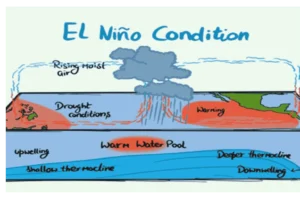
Warm phase of the El Niño–Southern Oscillation (ENSO) cycle.
Formation:
- Trade winds along the equator weaken.
- Warm water shifts eastward from Asia toward South America.
- Upwelling of cold water in the eastern Pacific is suppressed.
- This alters atmospheric circulation and global climate patterns.
Global Impacts
- Weather: Causes droughts in some regions (India, Australia) and floods in others (South America).
- Temperature: Raises global average temperatures.
- Ecosystems: Affects marine life by reducing nutrient upwelling, impacting fisheries.
- Economy: Influences agriculture, food security, and energy demand worldwide.
El Niño and India
- Monsoon Link: Often associated with weaker monsoon rainfall due to reduced land-sea temperature contrast.
- Agriculture: Impacts kharif crop sowing, especially rice, pulses, and oilseeds.
- Inflation: Can raise food prices due to lower yields

Conclusion
The IMD forecast points to a dual challenge: more heatwaves in several regions and possible monsoon disruption due to El Niño. This has direct implications for agriculture, economy, and disaster management.
CONVENTION ON THE CONSERVATION OF MIGRATORY SPECIES (CMS)
TOPIC: (GS3) ENVIRONMENT: THE HINDU
At the 15th Conference of Parties (COP15) to the CMS, 40 new species were added to the protected list, strengthening global efforts for migratory wildlife conservation.
About CMS
- Also Known As: Bonn Convention.
- Established: Signed in Bonn, Germany on 23 June 1979.
- Under: United Nations Environment Programme (UNEP).
- Mandate: Provides a global platform for conservation and sustainable use of migratory animals and their habitats.
- Unique Role: Only UN-based treaty dedicated exclusively to migratory species across terrestrial, aquatic, and avian ecosystems.
Key Features
- Conference of Parties (COP): Main decision-making body.
- Instruments: Parties adopt legally binding Agreements or informal MoUs for species protection.
- Appendices:
- Appendix I: Endangered migratory species — strict protection, including prohibition of hunting/harvesting.
- Appendix II: Species with “unfavourable conservation status” — encourages range-wide cooperative agreements.
Importance
- Recognizes the need for international collaboration, as migratory species cross multiple countries.
- Helps protect species facing threats from habitat loss, climate change, and hunting.
- Supports biodiversity conservation, aligning with SDGs and global environmental treaties.
Conclusion
The addition of new species at COP15 strengthens the Bonn Convention’s role in safeguarding migratory wildlife. For India, which hosts species like the Great Indian Bustard and Amur Falcon, CMS is vital in linking national conservation efforts with global frameworks.
20 CITIES TOWARDS ZERO WASTE INITIATIVE
TOPIC: (GS1) SOCIAL ISSUES: THE HINDU
Varkala has been selected in the inaugural 20 Cities Towards Zero Waste initiative, launched by the UN to highlight cities adopting innovative waste reduction and circular economy practices.
About the Initiative
- Led by: UN Secretary-General’s Advisory Board on Zero Waste.
- Supported by: UN-Habitat and UNEP.
- Objective:
- Showcase cities with strong waste management and circular economy models.
- Encourage exchange of best practices among global cities.
- Inspire others to accelerate their transition toward zero waste.
- Strengthen local-level implementation of circular economy approaches.
Importance
- Promotes sustainable urban systems that are resilient and inclusive.
- Recognizes city leadership in tackling waste challenges.
- Helps reduce environmental footprint and supports climate goals.
- Encourages collaboration between cities worldwide for knowledge sharing.
UNEP
- Founded: 1972, after a UN General Assembly resolution.
- Headquarters: Nairobi, Kenya.
- Mandate: Monitor global environment and coordinate responses to major challenges.
- Functions:
- Supports treaties like CBD, CITES, Minamata Convention.
- Publishes reports such as Global Environment Outlook and Emissions Gap Report.
- Provides technical and financial assistance to developing countries.
Conclusion
Such initiatives strengthen the push for circular economy, waste reduction, and climate resilience.